.
Canon EF 200 2.8L USM
Petite L Series Telephoto
Peter
Kun Frary
.
.
The EF 200 2.8 L, introduced in 1991, is one of my all-time favorite lenses. I bought it new in 1994 and grew to love its perspective, speed, sharpness, and feel. I used it around Oahu, shooting candids, portraits, and landscapes. The longer reach allowed me to isolate subjects from the urban clutter. The large aperture helps keep my images sharp and imparts a beautiful background blur. This is the longest lens I can hand-hold with consistent results, at least without IS.
Water Lily | Canon EOS A2E, EF 200 2.8L USM and Sensia 100

This review consists of my opinions and observations as a hobbyist. No scientific measurements, MFT charts or pixel peeking comparisons will be found here.
 Compatibility
This lens works on all Canon EOS SLR and DSLR cameras. It will also work on EOS R and M series mirrorless cameras with a mount adapter. It does not fit the FD mount and non-Canon cameras such as Pentax, Nikon, Fuji, etc.
 Construction
This handsome lens is
small and light for a fast telephoto, especially
when compared to the EF 70-200 2.8L IS USM.
It's also among a handful of black Canon L series telephotos, resulting in a more stealthy appearance compared to Canon's white telephotos. It focuses close
enough for head shots (1.5m). Because it
employs rear element focus, the front element
does not rotate nor does the lens change in
length. The 72mm filter size makes filters
expensive, but at least I can share filters with
my EF-S 15-85 3.5-5.6 IS USM.
EF 200 2.8L USM & EOS 3 | EOS 10D and EF 50 2.5 Compact Macro

The ring-type
USM focuses extremely fast. Like all ring-type
USM lenses, it has full time manual focus (FTM), i.e., ability to use manual focus while in AF mode, and a distance window.
Plus, the manual focusing ring is wide and turns
almost as smooth and precise as a manual lens.
Build quality is solid but sports more plastics
than larger L telephotos (barrel is mostly plastic).
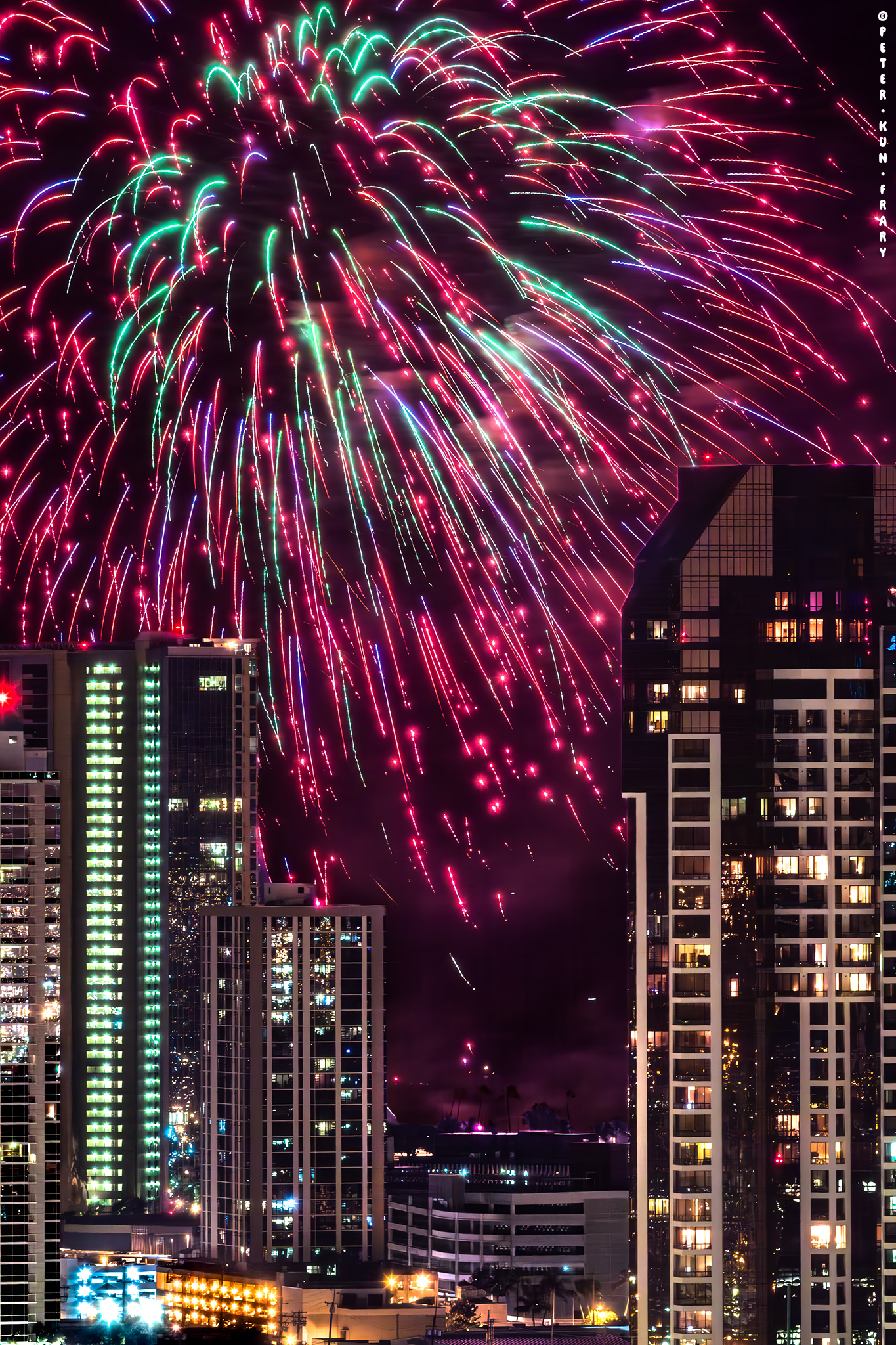
Honolulu Fireworks | EOS 50D, EF 200 2.8L USM, F8, 2.5 sec, ISO 100
The slide out hood is handy but
small. However, it's always there so it gets
used. The updated EF 200 2.8 L USM II has the same
optical design and exterior appearance, but has
a larger detachable hood. And while a larger detachable hood provides better shading, many of hoods are MIA because, well, they're detachable.
 Image Quality
This lens is sharp across the frame, contrasty, distortion-free, and highly flare-resistant. I can keep lens corrections disabled in Lightroom and it still looks great. I mainly use it wide open at F2.8, and it is very sharp but improves slightly stopped down to F4. Further stopping down further doesn't make much difference. The bokeh is smooth and pleasantly rendered, making a pleasing background for portraits.
Extenders
I often use this lens with the Extender EF 1.4x, resulting in a sharp, close-focusing, and compact 280 mm F4 lens. With this extender, it's smaller and nearly as good optically as the EF 300 4 L USM, except for a little flare under extreme conditions such as Hawaiian sunsets (it still has less flare than most zooms). If you own the EF 1.4x III, the coating is better and nixes most flare.
Tripod Mount Ring
You may add an optional tripod ring but it is only necessary if you use both an extender and extension ring. However, a tripod ring is more convenient to rotate from horizontal to vertical framing than adjusting a tripod head. Tripod Mount Ring A (black) is the original recommended mount, but the white version and updated Tripod Mount Ring A II work perfectly. If you own the EF 70-200 4L USM, EF 70-200 4L IS USM, EF 300 4 L USM or EF 80-200 2.8L (several other models as well), you already have a ring that fits.
Lily at Ala Moana | Canon EOS A2E, EF 200 2.8L USM, Fujichrome 100

 Last Blurb
I bought the EF 200 2.8L USM new in 1994, using it to shoot Fujichrome, Vevia, and Portra 160 until 2003. It proved to be extremely durable, and I continued shooting with it well into the DSLR and mirrorless era. Indeed, the image quality and AF speed held up amazingly well on my EOS R6 MK II and R7. I finally sold it because, at this point in my life, I needed stabilization (IS) and, preferably, both IS and IBIS. Unfortunately, IBIS alone is not effective at 200mm.
The EF 200 2.8L
USM is small, light, tough, discreet, fast and
delivers optical quality in spades. For
discriminating hikers, travelers and amateurs
this lens deliverers quality without breaking
their shoulder (and bank) and can take the
knocks they dish out. Plus, it works
well with both film and digital bodies, including R series cameras (with the RF to EF adapter).
If you find yourself mainly using the long end of a 70-200 telezoom, the EF 200 2.8L USM may be ideal for you.
Water Lily | EOS A2E, EF 200 2.8L USM and Fujichrome 100

 Features and Specs
Focal Length:
200 mm
Aperture:
F2.8
Lens
Construction: 9 elements in 7 groups with 2 UD
elements
Min. Focusing
Distance: 1.5 m/4.9 ft
Filter Size: 72
mm
Diameter and
Length: 83 x 136 mm
Weight: 790 g / 27.7 oz
Included
Accessories: Hard Case
Optional
Accessories: Tripod Ring A (black)
Price: In 2026, excellent used copies go for about $600 USD
More
EF 200 2.8L USM Images (click to
enlarge)
06/21/2001 | Revised 10/14/2026

©Copyright 2016-27 by Peter Kun Frary | All Rights Reserved
|
 •••••••
 •••••••
 •••••••
 •••••••
 •••••••